Industrial RO Membrane

You Professional Industrial RO Membrane Manufacturers


Established in 2006, Dongguan Yixuan Environmental Protection Technology Co., Ltd. is a professional manufacturer of industrial reverse osmosis (RO) membranes, dedicated to providing efficient and reliable water treatment solutions across a wide range of industries. We specialize in producing RO membranes that meet international standards, finding extensive application in industrial water treatment, wastewater reclamation, seawater desalination, and the food and beverage sector, among other fields. As an experienced supplier of RO membranes, we offer a diverse array of customized membrane solutions to assist clients in addressing complex water treatment challenges, optimizing water quality, and reducing energy consumption.

Our industrial RO membranes deliver exceptional water treatment performance, utilizing advanced membrane technology and high-quality raw materials to effectively remove dissolved solids, organic matter, bacteria, viruses, and other contaminants from water, thereby ensuring that water quality meets the highest standards. Through rigorous quality control and testing, our products feature high salt rejection rates, extended service life, and low maintenance costs, making them ideally suited for use in large-scale industrial facilities and commercial water treatment systems. Whether for OEM partnerships or bulk procurement, Yixuan stands ready to provide reliable support to our clients, fulfilling your specific customization requirements.


First
12
Last


Why Choose Us

Rich Experience

Backed by a skilled professionals and 20 Development, experienceincluding several PhDs and master's degree holders, the company holds five invention patents and other intellectual property rights.where the company has developed RO, NF, and specialized membranes recognized worldwide for their high performance.

Global Shipping

Our products have been exported to countries and regions such as India, Vietnam, Thailand, and the Philippines, and we have a complete global sales network and a loyal customer base.

Our Service

Specializing in the research, development, production, sales, and service of advanced membrane materials and components, we aim to deliver industry-leading solutions with exceptional customer support.


Advantages of Industrial RO Membrane


High-efficienc

RO membranes are very efficient and remove 99% of dissolved salts, particles, and other microorganisms from water.


Budget-friendly

Despite initial investment, RO systems can be budget-friendly in the long run because of their low operation costs and low maintenance.


Nature-friendly

RO membranes help reduce the environmental impact of industrial processes by purifying water and treating waste effectively.


Specification of Industrial RO Membrane


Industrial Reverse Osmosis MembraneSeries

Working Pressure (Psi)

Saltrejection rate (%)

Permeated Flow(GPD)

Feed Salt Concentration(mg/L)

Xtreme Low Pressure Series

100

98%-99.2%

350-13200

≤1500

Ultra Low Pressure Series

125

98%-99.3%

350-13200

≤2000

Low Pressure Series

150

99.3%-99.5%

300-12650

≤3000

Fouling Resistance Series

225

Up to 99.75%

300-12650

≤10000

Brackish Water Series

225

Up to 99.5%

300-12650

≤10000


RO Membrane - Classification by Membrane Structure


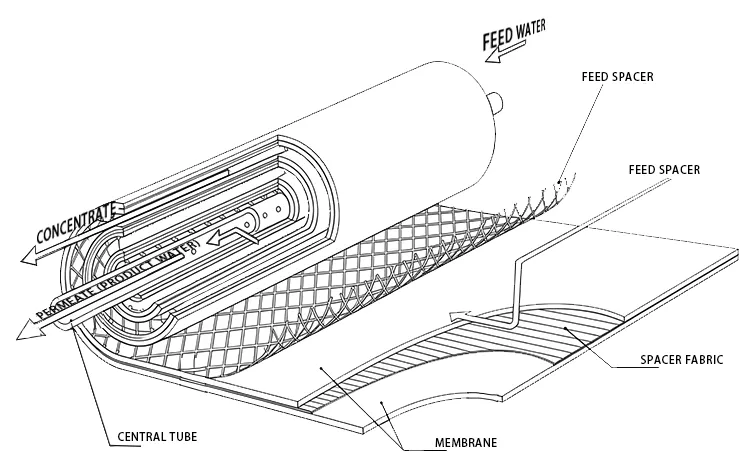
According to the structure of the membrane, reverse osmosis membranes are mainly divided into two categories: Spiral membranes and hollow fiber membranes. 

Spiral-Wound Membranes

Spiral-Wound Membranes are membrane sheets and spacer layers alternately wound around the central tube to form a compact cylindrical structure. Spiral-Wound Membranes have a high membrane area density and low pressure drop, and are the most commonly used membrane structure in current reverse osmosis systems.

Hollow Fiber Membranes

Hollow fiber membranes are composed of a large number of hollow fibers, and water is filtered through the inner cavity or outer surface of the hollow fiber. Hollow fiber membranes have a high membrane area and good anti-pollution ability.

8040 RO Membrane


Application of Industrial RO Membrane


Power Generation


Industrial RO membranes are used in power generation plants to purify water for boiler feedwater, cooling water, and other applications. The purified water helps prevent scale buildup and corrosion in the power generation equipment, increasing its efficiency and lifespan.

01

Food and Beverage Production


Industrial RO membranes are used in the food and beverage industry to purify water for use in production processes, such as cleaning, mixing, and cooling. The purified water ensures that the final product is of high quality and free from contaminants.

02

Pharmaceutical Manufacturing

Industrial RO membranes are used in pharmaceutical manufacturing to purify water for use in drug formulation, cleaning, and sterilization processes. The purified water helps ensure the safety and efficacy of the drugs.

03

Desalination


Industrial RO Membranes are used in desalination plants to remove salt and other dissolved solids from seawater, making them suitable for human consumption and other industrial uses.

04

Wastewater Treatment


Industrial RO membranes are used in wastewater treatment plants to remove pollutants and contaminants from wastewater before it is discharged into rivers or other bodies of water.

05


Material of Industrial RO Membrane

The RO membrane is typically composed of thin film composite (TFC) materials, which are known for their high permeability and salt rejection capabilities. TFC membranes are constructed from multiple layers of polymers, including:


Polyamide (PA) layer

The top layer of the RO membrane is made from polyamide, a polymer that is known for its strength and chemical resistance. This layer is crucial for rejecting larger molecules and ions, ensuring that only pure water passes through.


Microporous polyurethane (PU) layer

Below the polyamide layer, there is a microporous polyurethane layer. This layer is designed to enhance the membrane's permeability, allowing for a higher flow rate of purified water.


Support layer

The support layer, often made from polyester or polypropylene, provides structural integrity to the membrane. It supports the thin film layers and helps maintain the membrane's shape and function over time.


Precautions for use of Industrial RO Membrane

The changing time of RO Water Membranes depends upon the above factors. If the water has a very high level of impurities, and a high TDS level, then the RO Membrane would need to be replaced quite frequently. Some factors are needed to be considered before changing the RO membrane

The hardness of the water or TDS level.

The amount of water used in purifying the water.

Level of impurities and contaminants present in the water.


The RO Membrane on average should be replaced every 3-5 years. If it is still producing good quality water then may be able to keep longer than five years. RO Membrane price is very cost-effective and can be easily changed.


If RO Membrane is never cleaned, then the lifespan of RO membrane may get reduced. If the water has a sour taste or certain odor, it is time to go for a maintenance check.  


Our Certifications


productcate-1-1
productcate-1-1
productcate-1-1
productcate-1-1
productcate-1-1
productcate-1-1
productcate-1-1
productcate-1-1
productcate-1-1
productcate-1-1


FAQ


Q: Where is reverse osmosis commonly used?

A: Reverse osmosis is most commonly known for its use in drinking water purification from seawater, removing the salt and other effluent materials from the water molecules.

Q: How many types of RO membranes are there?

A: A reverse osmosis membrane is an essential product for handling water and wastewater. There are three other types of membranes, categorized by membrane pore size, widely used for commercial purposes: Microfiltration (MF), Ultrafiltration (UF ), Nanofiltration (NF).

Q: What is the pore size of the industrial RO membrane?

A: Reverse Osmosis (RO) Membranes: RO membranes have the smallest pore size of all membrane filters, ranging from 0.0001 to 0.001 microns.

Q: What is the difference between an 8040 and a 4040 membrane?

A: Size and shape:
From the size, it can be seen that the diameter of the 8040 reverse osmosis membrane is twice that of the 4040 membrane. Therefore, the 8040 membrane has a larger surface area, stronger filtration capacity, and a relatively large amount of water treatment.

Q: How to choose RO membrane?

A: Water Quality: The quality of your water source will determine the type of membrane you need. ...
Flow Rate: The flow rate of an RO membrane is measured in gallons per day (GPD). ...
Rejection Rate: The rejection rate indicates the percentage of contaminants the membrane can remove.

Q: What size RO membrane do I need?

A: A common standard size for residential RO systems is the 12-inch housing with 1/8″ female threaded connections. This size is suitable for most standard residential RO membranes with dimensions ranging from 1.5-1.8 inches in diameter and 10-12 inches in length.

Q: How often should RO membrane be replaced?

A: Certain industries follow rough guidelines with most pharmaceutical applications cleaning membranes at least every year and replacing on a set interval every 3-5 years, beverage manufacturers cleaning quarterly and running to fail within 3-7 years, and municipal and seawater replacing annually.

We're professional industrial ro membrane manufacturers and suppliers in China, specialized in providing high quality customized service. We warmly welcome you to wholesale industrial ro membrane for sale here from our factory. For price consultation, contact us.

Industrial RO Membrane LUP BW 4040 FR, Ro Membrane 8040, Ocean Reverse Osmosis