

Installing a water softener is widely regarded as an effective way to prevent scale formation in reverse osmosis (RO) systems.However, many plant operators discover that RO membrane scaling still occurs even after softening treatment. Differential pressure continues to rise, cleaning frequency increases, and membrane performance gradually declines.
The reason is simple: a water softener only removes hardness ions such as calcium and magnesium. It does not address all scaling substances or eliminate the complex chemistry that causes reverse osmosis membrane fouling.

Softening Does Not Remove Silica
One of the most common causes of membrane fouling is silica scaling. Water softeners operate through ion exchange, replacing calcium and magnesium with sodium ions. Silica, however, exists mainly as dissolved silicic acid or colloidal particles rather than charged hardness ions. As a result, it passes through the softener almost unaffected.
When feed water contains more than 30–40 ppm of silica, the concentration near the membrane surface can exceed its solubility limit, particularly in high-recovery RO systems. Silica then polymerizes and forms a glass-like deposit that strongly adheres to the membrane and is extremely difficult to remove with conventional acid cleaning.
| Parameter | Water Softener Performance |
|---|
| Calcium & Magnesium | Removed |
| Silica (SiO₂) | Not removed |
| Colloidal Silica | Not removed |
| Silica Scaling Risk | Remains high |
This is why groundwater sources with elevated silica frequently experience RO membrane scaling despite having excellent hardness removal.
Sulfate Scaling Can Still Develop
Removing hardness does not eliminate sulfate-related scaling. Industrial RO systems commonly encounter deposits such as calcium sulfate (gypsum), barium sulfate, and strontium sulfate. These compounds are governed by saturation chemistry rather than hardness alone.
Even water with relatively low calcium concentrations may still become supersaturated with sulfate salts inside the RO system. As water passes through the membrane elements, dissolved solids become increasingly concentrated, creating ideal conditions for sulfate precipitation.
| Common Sulfate Scale | Characteristics |
| Calcium Sulfate (CaSO₄) | Common in industrial feed water |
| Barium Sulfate (BaSO₄) | Extremely low solubility |
| Strontium Sulfate (SrSO₄) | Less common but difficult to remove |
For this reason, sulfate scaling remains one of the most frequent causes of reverse osmosis membrane fouling in systems using softened feed water.
High Recovery Rates Intensify Concentration Polarization
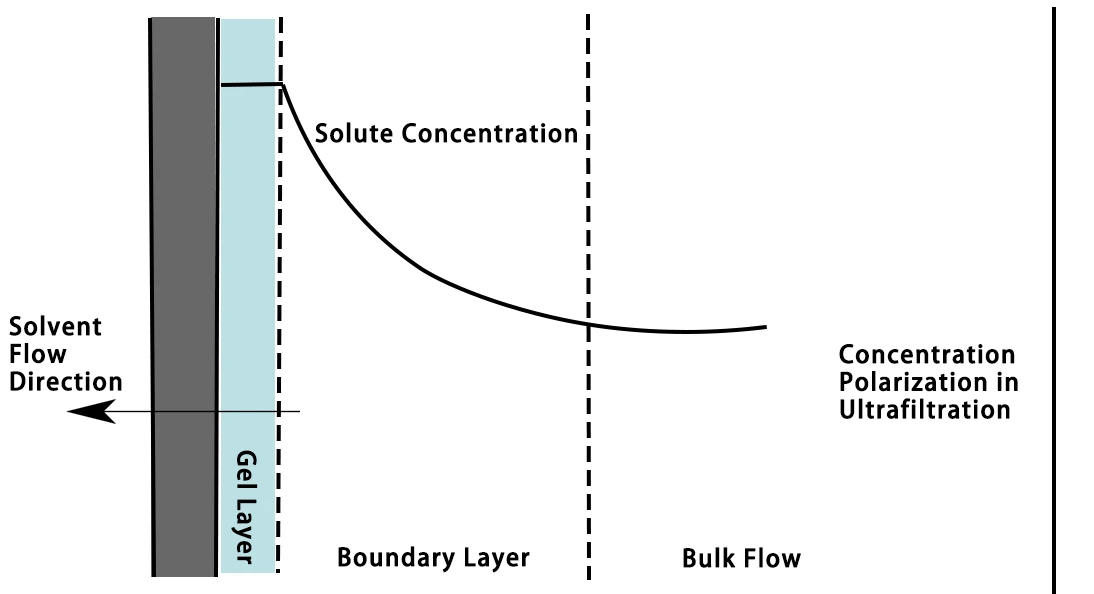
RO pretreatment quality alone cannot prevent scaling if the recovery rate exceeds design limits.
During operation, rejected salts accumulate near the membrane surface and form a concentration boundary layer. The salt concentration in this layer may be two to three times higher than in the bulk concentrate stream. In high-recovery systems, the concentration of scaling precursors inside the final membrane elements can reach five to ten times the original feed concentration.
Under these conditions, even softened water may become supersaturated, causing silica, sulfate salts, or residual hardness ions to precipitate and form scale deposits.
Softener Performance May Decline Over Time
Water softeners are not maintenance-free devices. Resin exhaustion, salt bridging, valve malfunctions, and incomplete regeneration can all result in hardness leakage.
Even a small hardness breakthrough of only 2–3 ppm can become highly concentrated inside a high-recovery RO system. Once concentrated several times over, these residual ions can still produce significant membrane scaling.
Regular monitoring of softener outlet hardness is therefore essential but is often overlooked in day-to-day plant operations.
Softened Water Still Requires Proper pH and Antiscalant Control
Another common misconception is that softened water no longer requires pH adjustment or antiscalant dosing.In reality, scaling behavior changes with water chemistry:
- Higher pH generally decreases silica solubility and increases the risk of silica scaling.
- Lower pH may control certain metal hydroxides but can promote other forms of precipitation.
- Generic antiscalants designed primarily for calcium carbonate control may offer limited protection against silica or sulfate scaling.
Many industrial RO systems therefore achieve the best results by combining water softening with carefully selected RO antiscalants and optimized pH control.
A water softener is an important component of RO pretreatment, but it is not a complete solution for membrane scaling prevention. Silica, sulfate salts, excessive recovery rates, softener performance issues, and improper chemical dosing can all contribute to reverse osmosis membrane fouling.
To maximize membrane life and maintain stable system performance, operators should evaluate the entire feed water chemistry rather than focusing solely on hardness removal. In many cases, the most effective strategy is a combination of softening, antiscalant dosing, proper recovery design, and continuous water quality monitoring.


