

Understanding the Role of RO Membrane 8040 and Cross-Flow Filtration
Reverse osmosis (RO) technology is one of the most effective methods for producing high-quality purified water. Among industrial RO products, RO Membrane 8040 is widely used for applications such as industrial water purification, seawater desalination, boiler feed water treatment, and wastewater reuse because of its excellent salt rejection performance and stable water production capacity.
The main purpose of an RO Membrane 8040 is to separate pure water molecules from dissolved salts, minerals, organic substances, and other impurities. However, achieving long-term and efficient separation is not only related to the membrane material itself. The operating principle behind the membrane system also plays a critical role.
One of the most important technologies supporting RO membrane performance is the cross-flow filtration principle. Unlike traditional dead-end filtration, where water flows directly toward and accumulates on the filter surface, cross-flow filtration allows feed water to flow parallel to the membrane surface. This continuous flow helps reduce fouling, maintain stable flux, and extend membrane service life.
Understanding how cross-flow filtration works provides a better explanation of why RO Membrane 8040 can maintain reliable performance in demanding water treatment systems.
What Is Cross-Flow Filtration?

The Basic Principle of Cross-Flow Filtration
Cross-flow filtration is a membrane filtration method where the feed water moves across the surface of the membrane instead of flowing straight through it.
In an RO system, high-pressure feed water enters the membrane element and flows along the membrane surface. A portion of the water passes through the membrane layer as purified water, known as permeate. Meanwhile, concentrated water containing rejected salts and contaminants continues moving through the system as concentrate.
This creates a continuous sweeping effect across the membrane surface. The flowing water helps carry away accumulated particles, dissolved solids, and rejected substances, preventing them from building up excessively on the membrane surface.
For RO Membrane 8040, this principle is essential because the membrane operates under high pressure and handles water sources that may contain high levels of dissolved salts, minerals, and organic matter.
Why Cross-Flow Filtration Is Critical for System Performance
The performance of an RO system depends not only on membrane rejection rate but also on maintaining stable water flow through the membrane. Without effective cross-flow movement, contaminants can accumulate quickly and form a concentration polarization layer.
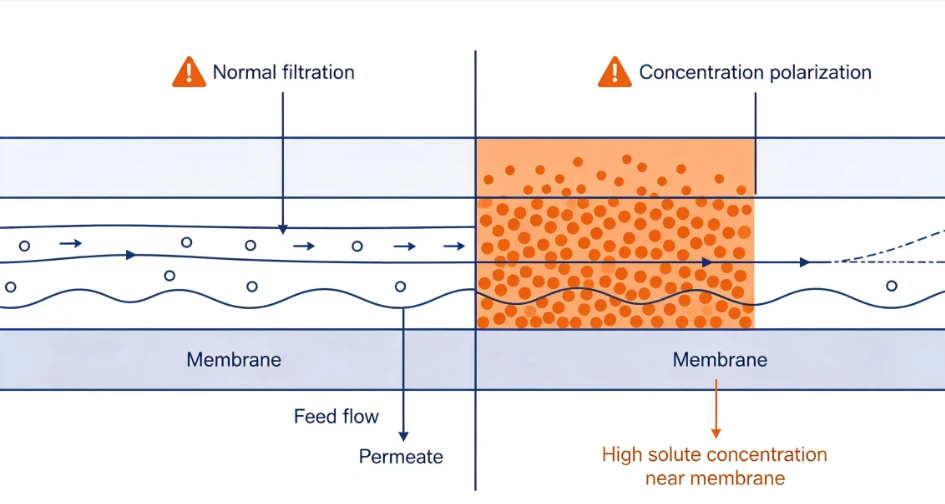
Concentration polarization occurs when rejected substances become highly concentrated near the membrane surface. This layer increases resistance to water movement, reduces permeate production, and may accelerate scaling or fouling.
Cross-flow filtration helps solve this problem by continuously removing concentrated substances from the membrane surface. As a result, the RO membrane can maintain Lower frequency of chemical cleaning and Reduced scaling and fouling risks
For industrial applications, these advantages are especially important because membrane replacement and system downtime can significantly increase operating costs.
The Important Role of Cross-Flow Filtration in RO Membranes
In an RO membrane system, the membrane surface acts as a selective barrier. Water molecules can pass through the membrane layer, while most dissolved salts and contaminants are rejected.
However, this separation process naturally creates a concentration difference between the feed water and the membrane surface. If the rejected materials remain near the membrane for too long, they may cause scaling, organic fouling, or biofouling.
The cross-flow filtration principle helps maintain membrane efficiency by creating continuous water movement along the membrane surface. This movement provides several important benefits:
Fouling is one of the biggest challenges affecting RO membrane performance. Common fouling sources include suspended solids, microorganisms, organic compounds, and mineral deposits.Because cross-flow continuously washes the membrane surface, it reduces the chance of contaminants attaching and forming a thick fouling layer. This allows the RO Membrane 8040 to operate more consistently over extended periods.
When fouling increases, water must overcome greater resistance to pass through the membrane. This leads to lower permeate flow and higher energy consumptionCross-flow filtration maintains cleaner membrane surfaces, allowing water molecules to pass through more easily. Therefore, the RO system can achieve more stable water production without increasing operating pressure unnecessarily.
Even with proper pretreatment and cross-flow operation, RO membranes may eventually require cleaning due to long-term exposure to contaminants.A membrane with controlled fouling levels is easier to clean because deposits are less compact and easier to remove. This helps restore membrane performance and reduces maintenance costs.
Which Membranes Use Cross-Flow Filtration Technology?
Cross-flow filtration is not limited to RO Membrane 8040. It is widely applied in many pressure-driven membrane technologies, including:

Reverse Osmosis (RO) Membranes
Reverse osmosis membranes are the most common application of cross-flow filtration. Industrial RO membranes, including 8040 size membranes, rely on this principle to achieve high salt rejection and stable operation.
Because the rejection process produces concentrated water, cross-flow operation is necessary to prevent excessive accumulation on the membrane surface.

Nanofiltration membranes also use cross-flow filtration. Compared with RO membranes, NF membranes have a more open structure and are often used for selective removal of multivalent ions such as calcium and magnesium.
Cross-flow helps NF membranes maintain separation efficiency while reducing scaling caused by hardness ions.

Ultrafiltration (UF) and Microfiltration (MF) Membranes
Ultrafiltration and microfiltration systems also commonly use cross-flow designs, especially in industrial water treatment applications.
These membranes mainly remove suspended solids, bacteria, and larger particles. Cross-flow operation helps prevent rapid blockage and improves filtration stability