

What Factors Affect RO Membrane Flux?
During the operation of a reverse osmosis water treatment system, "membrane flux" is a very important operating parameter. Whether in household RO systems, commercial water purification equipment, or industrial reverse osmosis plants, changes in membrane flux directly affect water production efficiency, system stability, and the service life of membrane elements.
So, what is membrane flux? What factors affect it? And how can flux decline be solved? Taking YIME products as an example, this article analyzes these questions from the perspective of actual system operation.
Membrane flux refers to the amount of permeate water produced through a unit membrane area within a certain period of time. It is commonly expressed in LMH or GPD.
Membrane flux reflects the water production capacity of a reverse osmosis membrane. The higher the membrane flux, the more purified water the membrane element can produce per unit area.
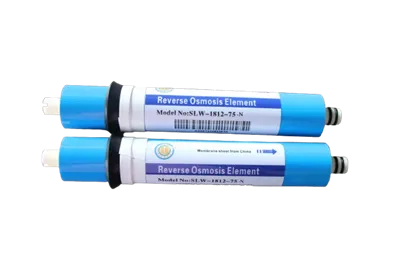
Generally speaking, membrane flux is also an important indicator for evaluating membrane performance, so most manufacturers provide detailed specifications for it. For example, in YIME-1812-75 and YIME-3213-600, the suffixes "75" and "600" represent the daily water production capacity of the membrane element under standard test conditions, measured in GPD.
By converting the daily water output and the effective membrane area, the standard membrane flux can be calculated.
The higher the membrane flux, the higher the water production efficiency of the system is usually. Under the same operating conditions, a high-flux membrane can produce purified water more quickly, thereby improving the overall water production capacity of the system.
For instance, high-flux household membranes can provide more purified water in a shorter period of time, making them more suitable for multi-person households or high-frequency water usage scenarios.
However, higher membrane flux is not always better. If the membrane flux is too high, contaminants on the membrane surface are more likely to accumulate rapidly, which may increase the risk of membrane fouling and scaling, and even affect the service life of the membrane element and the operational stability of the system.

Therefore, in practical applications, it is necessary to comprehensively evaluate factors such as feed water quality, water demand, operating conditions, and recovery rate in order to select a reverse osmosis membrane with an appropriate flux range, achieving a balance between water production efficiency and system stability.
In actual operation, the flux of YIME reverse osmosis membranes is not constant. It is affected by several factors, including pressure, temperature, water quality, and membrane fouling.
First, pressure and temperature directly influence membrane productivity. The reverse osmosis process relies on pressure to overcome osmotic pressure. Within the normal operating range, higher feed water pressure provides greater driving force for water molecules to pass through the membrane surface, resulting in increased membrane flux.
At the same time, temperature also has a significant impact on flux. As water temperature rises, water viscosity decreases and the diffusion speed of water molecules increases, which improves membrane flux. Under normal conditions, water production increases by approximately 2.5%–3% for every 1°C rise in temperature. This is also why RO systems usually experience lower water production during winter.
In addition, feed water salinity can also affect membrane flux. The higher the salt concentration (TDS) in the feed water, the greater the osmotic pressure. Under constant feed pressure, the effective driving force decreases, leading to lower membrane flux. Therefore, seawater desalination systems and high-salinity wastewater treatment systems generally require higher operating pressure.
Membrane fouling and scaling are also major causes of flux decline. During long-term operation, colloids, organic matter, microorganisms, calcium, magnesium, and other contaminants gradually accumulate on the membrane surface, forming fouling or scaling layers. These deposits increase water flow resistance and reduce the efficiency of water molecule permeation. If not treated in time, severe fouling may even cause irreversible membrane damage.
When membrane flux decreases during system operation, the issue can usually be improved by adjusting operating parameters, performing chemical cleaning, and strengthening pretreatment.
For example, under low-temperature winter conditions, the feed water temperature or operating pressure can be appropriately increased to maintain stable water production efficiency. When membrane flux decreases by about 10%–15% compared with the initial condition, chemical cleaning is recommended. Acidic cleaning agents are generally used to remove inorganic scaling, while alkaline cleaning agents are used to remove organic matter and biological fouling, thereby restoring membrane flux.
At the same time, an effective pretreatment system is also very important. Through sand filtration, activated carbon filtration, softening treatment, and security filtration, contaminants entering the RO membrane system can be significantly reduced, lowering the risk of membrane fouling from the source.
If the membrane element has been used for a long time and the membrane flux still cannot recover after thorough cleaning, it usually indicates irreversible membrane aging. In this case, the membrane element should be replaced in time to ensure stable system operation and water quality.