

Reverse osmosis (RO) membranes play a key role in drinking water production, seawater desalination, and industrial wastewater reuse. Their performance is often measured by salt rejection, permeate flux, and resistance to membrane fouling. However, these factors depend on more than membrane pore structure. Surface charge is another important property that affects how a membrane interacts with water and dissolved substances.
So, do reverse osmosis membranes carry an electrical charge? Why does this matter, and how does surface charge affect membrane performance during operation? Understanding these questions can help engineers select suitable membranes and design more reliable water treatment systems.
Do Reverse Osmosis Membranes Have a Surface Charge?
Yes. Most modern thin-film composite RO membranes have a surface charge when they contact water. Many commercial polyamide RO membranes carry a negative surface charge under neutral or mildly alkaline conditions. This charge mainly comes from ionizable chemical groups in the membrane's active layer.
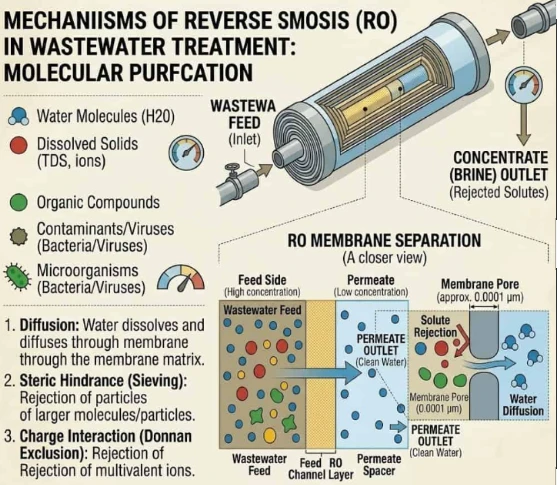
Generally, most commercial polyamide reverse osmosis (RO) membranes carry a negative surface charge in neutral or mildly alkaline aqueous solutions. This charge mainly originates from ionizable chemical groups in the membrane's active layer, such as carboxyl groups. However, not all RO membranes remain negatively charged under every water condition. The surface charge can change depending on the chemical properties of the water.
When a charged membrane surface comes into contact with water, it interacts electrostatically with cations, anions, and other charged substances in the water. In general, like charges repel each other, while opposite charges attract. These interactions cannot be observed directly with the naked eye. Instead, they are part of the membrane material's surface electrochemical properties.
Membrane surface charge does not remain constant under all conditions. It is affected by factors such as water pH, salt concentration, and ion type. For example, changes in pH can alter the ionization state of functional groups on the membrane surface, thereby changing its surface charge. Higher salt concentrations can weaken the influence of electrostatic interactions over longer distances. As a result, interactions between the same RO membrane and contaminants in the feed water may differ under different operating conditions.
How Does Membrane Surface Charge Affect Performance?
Surface charge affects how dissolved ions and other contaminants interact with the membrane, which can influence salt rejection, permeate flux, and membrane fouling. These performance indicators are closely related. For example, a membrane with good salt rejection but severe fouling may require more frequent chemical cleaning and consume more energy during operation. Conversely, a membrane with high water permeability but insufficient salt rejection may fail to meet the required permeate quality.
1. Effect on Salt Rejection
Surface charge can influence the rejection of specific ions through electrostatic interactions. For example, a negatively charged membrane surface may repel anions such as sulfate and nitrate, contributing to the membrane's selective separation performance.
However, RO membrane salt rejection does not depend on surface charge alone. The structure of the active layer, ion hydration characteristics, feed-water salinity, and operating pressure also affect the final rejection performance. Therefore, a stronger negative surface charge does not necessarily mean higher rejection of every type of salt.
When treating water with high nitrate or sulfate concentrations, the membrane's ability to reject the target ions should be evaluated using actual feed-water characteristics, operating conditions, and membrane performance test data. Treatment performance should not be judged solely by the membrane's surface charge.
2. Effect on Permeate Flux
Permeate flux is the volume of water passing through a unit membrane area per unit time. It is an important indicator of an RO membrane's water production capacity.
Surface charge may influence water transport by changing interfacial interactions between the membrane, water molecules, and dissolved ions. However, it is not accurate to assume that a stronger surface charge always results in lower permeate flux, or that a weaker charge always leads to higher flux. Actual performance also depends on the membrane's chemical structure, hydrophilicity, thickness, operating pressure, temperature, and feed-water quality.
Therefore, RO membrane selection should consider both salt rejection and permeate flux to ensure that the membrane element meets the required permeate quality while maintaining stable water production.
3. Effect on Membrane Fouling
Membrane surface charge can also influence fouling by changing the attractive or repulsive interactions between the membrane and contaminants.
Many natural organic substances, such as humic acid and fulvic acid, carry a negative charge under common water-treatment conditions. A negatively charged RO membrane may therefore repel some of these substances, reducing their tendency to attach to the membrane surface and potentially helping to mitigate organic fouling.
However, this effect does not apply to all contaminants. Ions in the water can change the strength of electrostatic interactions, while the charge characteristics of the contaminants themselves also affect how they interact with the membrane surface. In addition, inorganic scaling and biological fouling are influenced by various other factors, including mineral concentration, pH, microbial characteristics, and operating conditions.
Therefore, membrane fouling cannot be controlled through surface charge alone. Appropriate pretreatment, well-designed operating parameters, and regular cleaning and maintenance are also necessary to maintain stable, long-term RO system performance.